The Most Time-Consuming Part of Quality Planning Is Also the Most Automatable
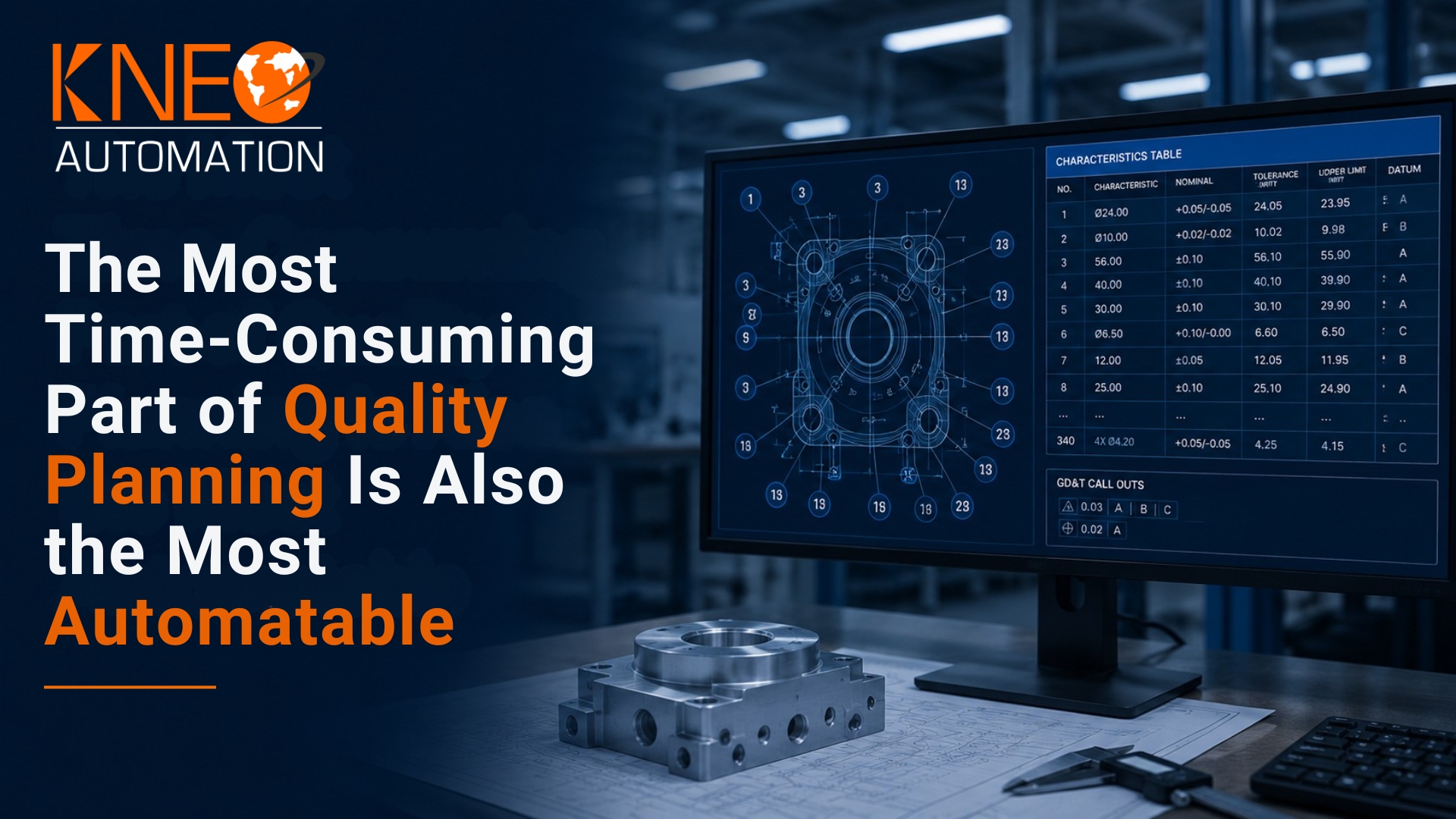
340 dimensions. Multiple GD&T callouts. Revision F - meaning five previous revisions, each with its own change history that needs to be reconciled against the current drawing. The quality engineer opens the PDF and begins placing numbered circles, one dimension at a time.
The Time Cost of Manual Ballooning
This is not a hypothetical scenario. It is a Tuesday morning at thousands of precision parts suppliers across the country. Manual ballooning of a complex engineering drawing takes an experienced quality engineer between four and eight hours. Not because engineers are slow. Because the task is genuinely time-consuming: every dimension identified, every GD&T callout interpreted, every balloon placed, every specification and tolerance entered into the inspection spreadsheet by hand. A supplier managing twenty active part numbers - each potentially on its third or fourth revision - is not doing this occasionally. It is a continuous background consumption of some of the most skilled hours in the quality function.
What Automation Actually Does in This Context
The software receives the drawing file - PDF, PNG, TIFF, JPEG, any common format. It identifies the dimensions. It identifies the GD&T callouts, including type, datum, and tolerance value. It places numbered balloons on the drawing in a configured sequence. It generates the control plan spreadsheet - balloon number, specification, nominal, upper limit, lower limit, measurement class - pre-populated and ready for review. The engineer's role shifts from data entry to data verification. The process that consumed most of a working day now consumes under thirty minutes. And because the data comes directly from the drawing rather than being re-entered by hand, it contains no transcription errors.
The Downstream Effect on Quality System Integrity
The value of getting the ballooning right extends well beyond the ballooning itself. The control plan flows from the ballooned drawing. The PFMEA references the control plan. The inspection plan references both. When the foundation document is complete and accurate, every downstream document benefits. When it is incomplete - when Characteristic 23 was missed because the engineer ran out of time, or when a tolerance was entered incorrectly because the GD&T callout was ambiguous - every downstream document inherits that error. The risk here is not the time lost to re-work. It is the quality system that silently operates on a flawed characterisation of the part.
The Audit Situation That Makes This Concrete
An IATF 16949 audit proceeds from a simple premise: your quality system claims to control what your customer's drawing specifies. Demonstrate it. If the drawing has 340 characteristics and the inspection plan has 318, the question is immediate: where are the other 22? The answer that follows from manual ballooning - that they may have been missed during a busy week - is not the kind of answer that gives an auditor confidence. The answer that follows from automated ballooning - that all 340 were extracted and all 340 are in the plan - is.
The fastest path to a complete, accurate inspection plan is the one that does not depend on someone having enough time to do it manually. www.kneo.in