A Warehouse That Thinks: What Fully Automated Storage Actually Looks Like in Practice
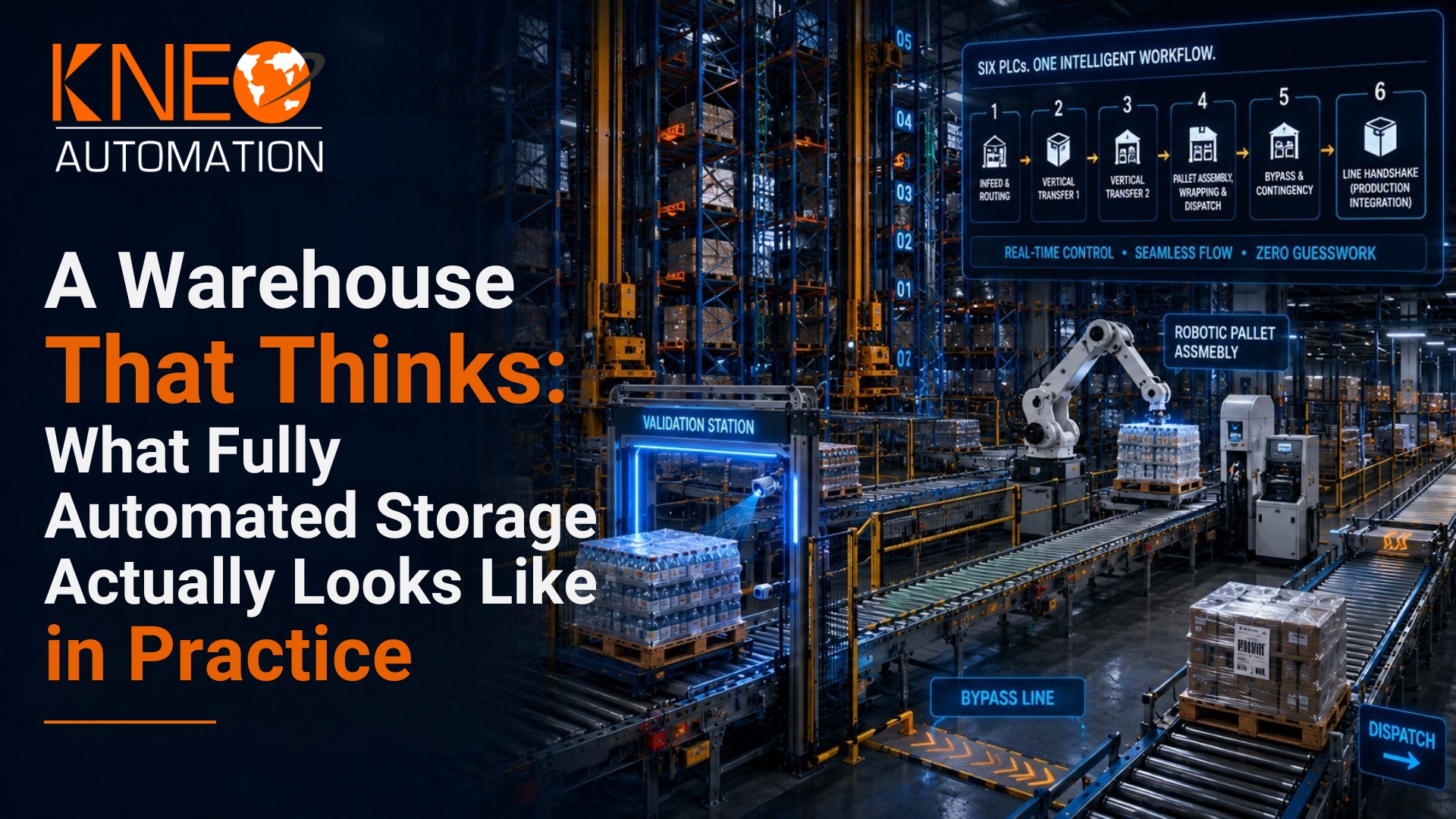
The gap between an automated warehouse in a capabilities brochure and an automated warehouse on a factory floor is measured in engineering decisions. Here is what one of the more complex ones actually involved.
The Scale of the Problem
A major beverage manufacturer needed to eliminate the manual bottleneck between its production lines and its distribution operation. Product was coming off six filling lines faster than it could be manually palletised, labelled, and moved to storage. The solution had to handle inbound pallets from multiple lines simultaneously, route them to the correct storage location based on real-time inventory, retrieve them on demand, and in some cases break them down and reassemble them as mixed-product pallets for specific distribution orders. None of this could create a queue that backed up into production.
Six PLCs, One Workflow
The architecture was built around six PLCs, each with a defined domain of control. PLC-1 governed the infeed: every pallet entering the system was assessed and routed — to storage or directly to dispatch via the bypass line. PLCs 2 and 3 controlled vertical movement into the racking structure, communicating real-time with the WMS to confirm storage slot assignment before committing to placement. PLC-4 managed the robotic mixed-pallet assembly station, wrapping, label printing, and dispatch staging. PLC-5 was the contingency controller — a deliberate design decision ensuring the facility could continue moving product during any partial system fault. PLC-6 was the protocol translator, managing the handshake between the production line conveyor control and the warehouse system. Together, they formed a single workflow.
The Validation Layer That Most Designs Overlook
Every pallet that entered the racking system passed through two checks that most warehouse automation diagrams do not show. First: a shape and profile verification. A pallet that is 15mm out of profile can wedge in a high-density rack at height, potentially damaging adjacent pallets and shutting down a section. This check is unglamorous. It is not in any sales presentation. It is what prevents the class of failure that makes headlines. Second: a simultaneous barcode and weight verification. Identity confirmed. Load within rated limits. Only then does the system commit to storage. These validation steps cost microseconds. Skipping them costs far more.
The Bypass Line: A Design Decision Worth Highlighting
Production lines have commercial priorities. There will always be orders that need to move from line to truck faster than the standard storage-and-retrieval cycle allows. The bypass line in this design - managed by PLC-1 under normal conditions and PLC-5 during system maintenance windows - meant the automated warehouse never became a constraint on production velocity. This design decision reflects a principle that is easy to articulate and often skipped in practice: the automated system must serve the business, not the other way around.
The most sophisticated warehouse automation is the kind that still works when something unexpected happens. www.kneo.in