

Collisions & reach limits
Robot paths that clash with fixtures, guarding or each other — including during fault-recovery moves nobody normally simulates.
Imagine catching every glitch, collision and programming error before your system ever touches the shop floor. That's the power of virtual commissioning — a digital twin of your automation system that lets us test, refine and perfect everything in a risk-free virtual world.
Traditional commissioning discovers logic faults with the machine in front of you, the customer watching, and a production window closing. Every fix costs downtime, travel and credibility.
On overseas installations the arithmetic is worse still: a problem that takes two hours to fix can take two days to reach.
Less unexpected downtime, a faster startup, and a system that behaves on day one the way it did in simulation.
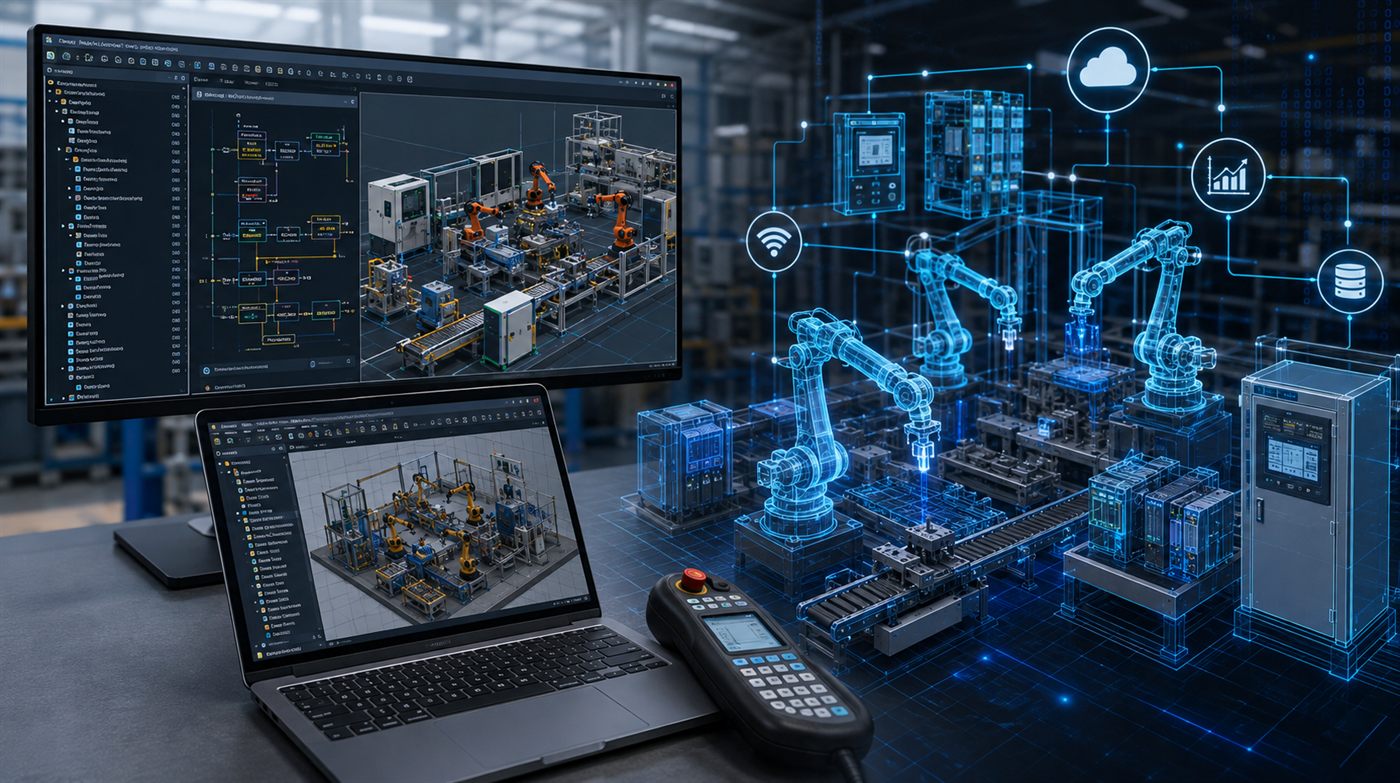
A digital twin is not an animation. It is a physics- and signal-accurate model of your equipment, connected to the same PLC and robot programs that will ship.
Every one of these is routine to find in simulation and painful to find on a running machine.
Robot paths that clash with fixtures, guarding or each other — including during fault-recovery moves nobody normally simulates.
Deadlocks, missed handshakes and states the sequence cannot recover from without a power cycle.
Discover the cell is 1.8 seconds over takt while it is still cheap to change the mechanical concept.
Wrong addresses, inverted signals and missing feedback found before anyone is on a ladder with a meter.
Faults that stop the machine without telling the operator anything useful about why.
HMI sequences that are logical to an engineer and confusing to the person actually running the shift.
Overseas installations where onsite time is expensive
Tight shutdown windows in existing plants
Multi-robot cells with complex interaction
High-mix lines with frequent changeover
Virtual commissioning validates the same code we write — not a simplified stand-in.
Service 03Included as standard on complex multi-robot cells we design and build.
Service 08Arrive on site to install and prove a system that has already been debugged.
Looking for something else?
If your next installation is overseas or inside a shutdown window, this is the conversation to have first.
We value your privacy
This site stores a small amount of data on your device to remember your theme choice. If you accept, we will also measure how the site is used so we can improve it. Read our Privacy Policy.
We'll respond quickly within one business day!